@Eli5defi: Three years writing about crypto forced me to learn everything

Submit
@Eli5defi
@Eli5defi

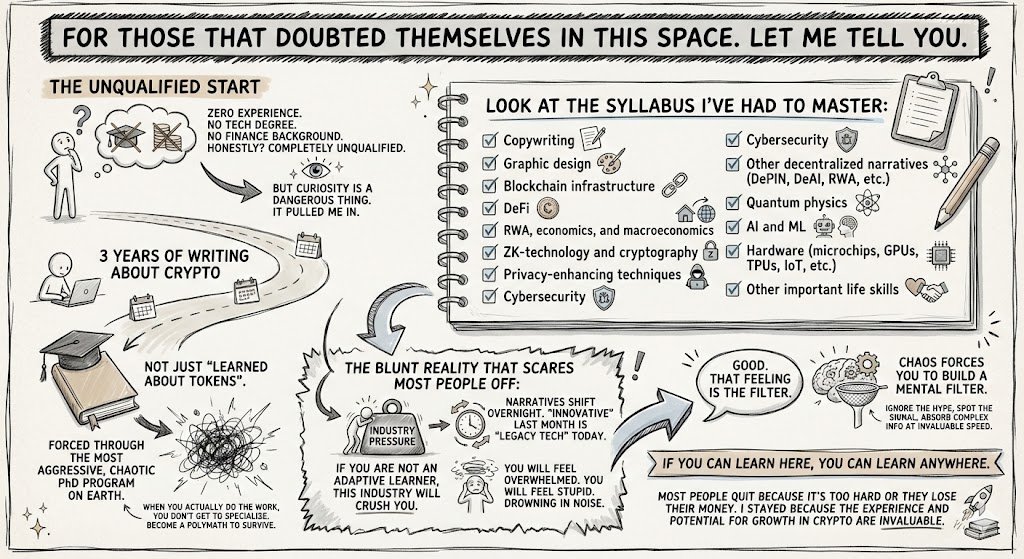
For those that doubted themselves in this space. Let me tell you. I started with zero experience. No tech degree. No finance background. Honestly? I was completely unqualified. But curiosity is a dangerous thing. It pulled me in. Three years of writing about crypto later, and I haven't just "learned about tokens." I’ve been forced through the most aggressive, chaotic PhD program on earth. When you actually do the work in this industry, you don't get to specialize. You have to become a polymath just to survive any markets. Look at the syllabus I’ve had to master just to keep up: - Copywriting - Graphic design - Blockchain infrastructure - DeFi - RWA, economics, and macroeconomics - ZK-technology and cryptography - Privacy-enhancing techniques - Cybersecurity - Other decentralized narratives (DePIN, DeAI, RWA, etc.) - Quantum physics - AI and ML - Hardware, including microchips, GPUs, TPUs, IoT, etc. - Other important life skills Here is the blunt reality that scares most people off: If you are not an adaptive learner, this industry will crush you. The narratives shift overnight. What was "innovative" last month is "legacy tech" today. You will feel overwhelmed. You will feel stupid. You will feel like you are drowning in noise. Good. That feeling is the filter. The chaos forces you to build a mental filter that others simply don’t have. You learn to ignore the hype, spot the signal, and absorb complex information at a speed that is invaluable in any other sector. If you can learn here, you can learn anywhere. Most people quit because it's too hard or they lose their money. I stayed because the experience and potential for growth in crypto are invaluable. h/t Google Gemini for Infographic Generation

Tweet image
x.com

Three years writing about crypto forced me to learn everything

AI summary of the linked article

A crypto writer, posting under the handle @Eli5defi, argues that three years of writing about the industry forced them to learn a wide range of fields, and that adaptive learning is essential to surviving there. The post lists the subjects they had to master, including copywriting, DeFi, ZK-technology, cybersecurity, AI and ML, and hardware such as GPUs and TPUs. It also says that the industry's fast-shifting narratives create a discomfort that acts as a filter, teaching people to ignore hype and absorb complex information quickly.

No comments yetWhat caught your eye? Start the discussion.